
Literacy

"There is no such thing as a child who hates to read; there are only children who have not found the right book."
Frank Serafini - Professor of Literacy Education.
At Sunshine Harvester Primary School, we have adopted an evidence-based, structured approach to reading and literacy instruction, as recommended by the Victorian Department of Education. These essential pillars form the foundation of reading curriculums in Victorian schools. The key elements of reading are the ‘Big 6’ (Konza, 2014):
- Oral language – knowing and using spoken words to express knowledge, ideas and emotions
- Phonemic awareness – which is the knowledge of sounds (phonemes)
- Phonics – knowing the sound (phoneme) and letter (grapheme) relationships
- Fluency – reading accurately and at an appropriate rate with expression
- Vocabulary – understanding words in isolation and in context
- Comprehension – making meaning from text which includes developing knowledge of grammar.
These foundational skills have a reciprocal relationship and are all necessary to enable students to independently read and respond to increasingly complex fiction and non-fiction texts.
In the early years of school, the development of decoding skills is best achieved through a program that includes at least 25 minutes of daily explicit teaching of phonics and phonemic awareness, using a systematic synthetic phonics approach.
Phonics is a way of teaching reading and writing by connecting sounds with letters or groups of letters. Phonic skills help children understand how letters link to sounds in spoken language and how those letters work together to form words. Children are supported to read and spell words by learning sound-letter relationships, and using these relationships to blend sounds together when reading, and to segment sounds when spelling. Programs we use are Little Learners Love Literacy, Sound Check, and Levelled Literacy Intervention (LLI).
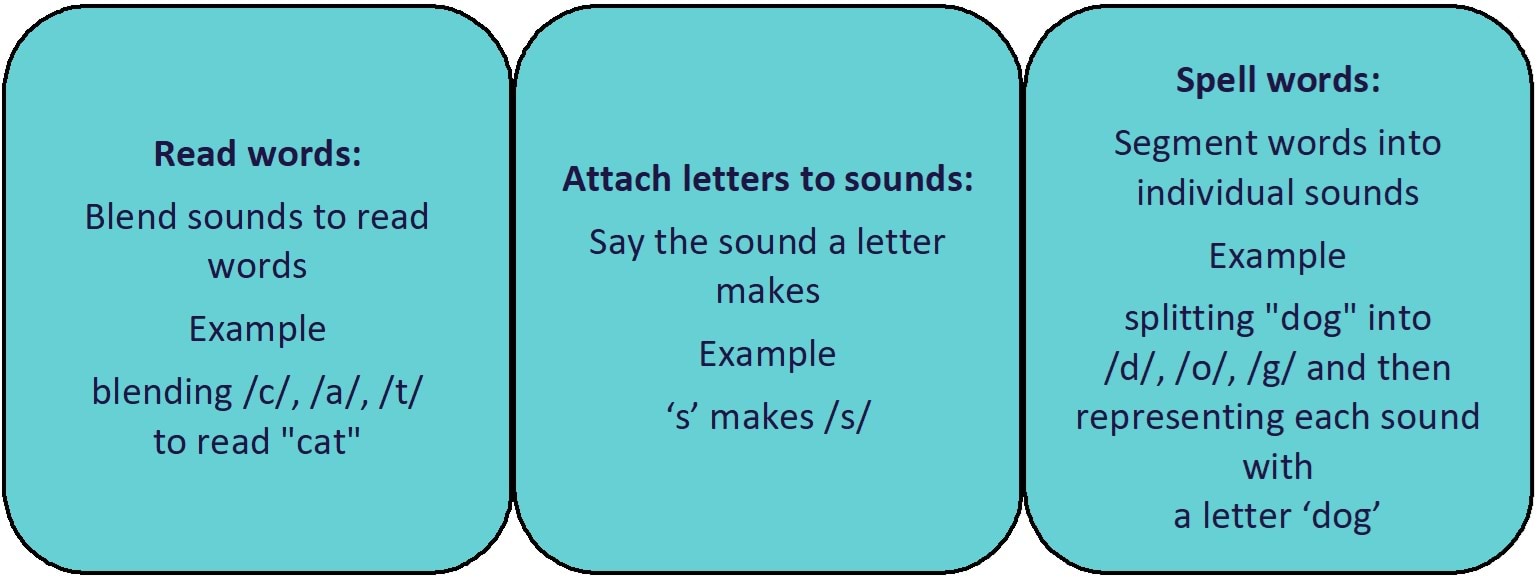
Image from Phonics: A guide for parents and carers
Further Reading: Useful links:
© Copyright Sunshine Harvester Primary School